Beat Piano Dance:music game
- 4.4
- Rating
- 50.00M
- Installs
- Free
- Price
 Analysis by App-foxy
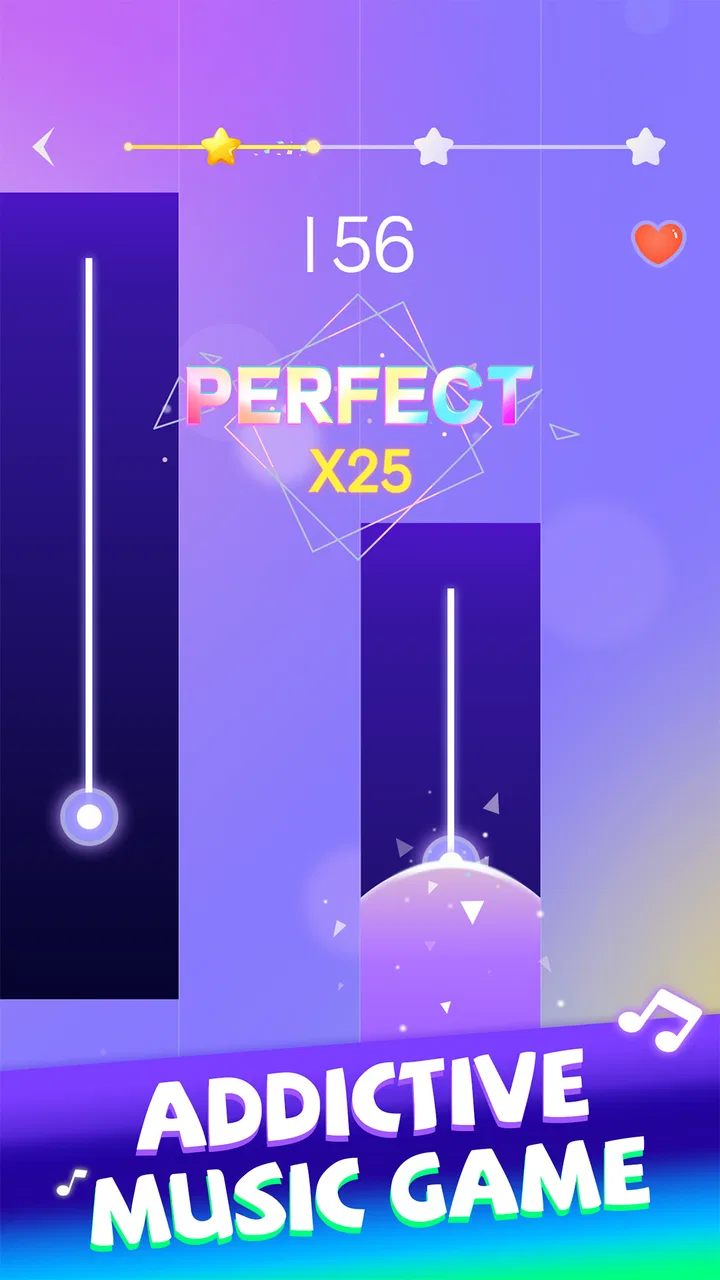
I picked up Beat Piano Dance:music game expecting a quick music game for spare moments, and that is exactly where it makes the most sense. The basic idea is easy to understand: follow the rhythm, tap at the right time, and keep your fingertips moving with the song. It feels closer to an arcade reflex challenge than to a traditional piano-learning tool, so the appeal comes from timing, concentration, and the satisfaction of completing a musical sequence rather than from learning to play an instrument.
That distinction matters before you download it. I would recommend it to someone who wants a lightweight rhythm game that can fill a short break, especially if familiar piano-style tapping sounds more attractive than a complex music simulator. I would not choose it as a substitute for piano lessons, sheet-music practice, or a deep rhythm-game experience built around detailed customization. Its strength is immediate play, while its limitations become clearer when you want more control, more musical depth, or a carefully structured long-term challenge.
How the first sessions create momentum
The opening experience is built around a very clear early goal: make it through the song without losing the rhythm. That simplicity works in the app’s favor. I do not need to study a long explanation before playing, and the piano presentation gives the action an obvious visual identity. The first few attempts are about learning the relationship between what appears on screen and when I should tap, rather than managing a complicated set of controls.
You May Also Like

 AccuWeather: Weather Radar
AccuWeather Review: A Quick, Clear Forecast for Everyday Decisions
For everyday plans, the best forecast is the one you can understand quickly. AccuWeather makes rain timing, radar, and local conditions easy to act on, with a few trade-offs.

 Hill Climb Racing
Why Hill Climb Racing Still Turns Crashes Into One More Run
A tiny car, a bumpy hill and one more upgrade: Hill Climb Racing keeps resurfacing because its simple chaos makes every near-miss feel personal.

 AliExpress - Shopping App
AliExpress Makes Global Shopping Feel Personal, but Shoppers Bear the Risk
AliExpress turns a global marketplace into a pocket-sized discovery engine. Its reach is useful, its shopping loop compelling, and its trade-offs easy to miss.

 Lords Mobile: Kingdom Wars
Lords Mobile Is a Kingdom-Building Routine, Not a Quick Match
A case-by-case verdict on the building, battles, device demands, and social commitments that make Lords Mobile rewarding for some players and exhausting for others.

 PDF Scanner app - TapScanner
TapScanner Makes Paperwork Easier to Capture, Check, and Share
TapScanner makes scanning with a phone feel less like a rescue operation and more like a dependable step in getting work done. Its capture tools are useful, though not flawless.

 Block Blast!
 Shows How Much a Puzzle Game Can Leave Out
A quiet grid game shows why puzzle players increasingly value instant clarity, repeatable skill and low-pressure play—and where the genre still needs to catch up.
More From Our News Desk
View All News


This is the kind of design that suits a phone held in one hand during a short pause. A commute, a waiting room, or a few minutes before bed can be enough time for a meaningful attempt. The game does not ask me to build a character, arrange a team, or remember a large collection of rules before I can enjoy it. I can start with the central action immediately and decide for myself whether the rhythm feels satisfying.
That early accessibility also reveals the first trade-off. Because the main interaction is so direct, the novelty depends heavily on how much I enjoy repeating timing patterns. Players who like improving through retries will probably find the loop inviting. Players who need a strong story, exploration, or a large strategic layer may feel that the first goal is too narrow. The game knows what it is: a focused music challenge, not a broad adventure.
I also found that the best way to approach the opening is not to chase speed immediately. Watching the movement for a moment helps establish a visual rhythm before I start tapping aggressively. If an early attempt goes badly, I get more value from identifying whether I rushed, hesitated, or lost concentration than from simply repeating the same behavior. That small change in mindset turns the first sessions from random tapping into a practical exercise in timing.
What progress feels like during ordinary play
Progress in a game like this is felt less through a complicated character sheet and more through personal consistency. I notice improvement when a section that once demanded all my attention starts to feel readable, or when I can maintain a rhythm without constantly looking away from the next note. Those are modest signals, but they are meaningful because they come directly from my own performance.
The useful question after a failed run is not only whether I finished. I ask myself where the pattern became difficult and whether the problem was speed, distraction, or an awkward hand position. That makes each retry more informative. A player who treats every attempt as feedback will get more from the game than someone who expects automatic progress after pressing replay.
There is also a practical physical consideration. Long sessions can become uncomfortable because the game asks for repeated fingertip movement and sustained visual attention. I prefer short bursts, keeping the phone steady and avoiding a grip that forces my tapping hand into an unnatural angle. This is not a dramatic flaw, but it changes how I use the app: it works better as a series of focused sessions than as something I leave running for an entire evening.
The app’s popularity gives it social proof without changing the personal nature of its progression. It has an average rating of 4.4 from around 301 thousand ratings and has passed 50 million installs, which suggests that the quick rhythm format has found a broad audience. I still would not interpret that reach as proof that every player will enjoy it. Music taste, patience for retries, and tolerance for repeated patterns matter much more here than the size of the audience.
Where the difficulty curve works and where it can feel abrupt
The challenge is most enjoyable when I can see why a section is harder. A faster sequence, tighter timing, or a denser run of notes gives me something specific to practice. The game feels fair when my failure points to a skill I can improve. In those moments, the difficulty creates a useful loop: observe, retry, adjust, and eventually play the passage with less hesitation.
The opposite experience is more frustrating. When several inputs arrive quickly, a small lapse in attention can spoil an otherwise strong attempt. That is common in rhythm games, but it means the experience can change sharply depending on my surroundings. A quiet room helps me focus; background conversation, a poor grip, or a notification can make the same sequence feel much less forgiving. I would use headphones or a quieter setting when I want to concentrate, while remembering that the game remains a visual challenge rather than relying only on sound.
One of my more useful habits was separating practice from performance. During practice, I concentrate on the troublesome transition and accept that the run may end. During a serious attempt, I stop experimenting and follow the established rhythm. Mixing those two approaches often makes me tense, which leads to premature taps. This is a small but valuable way to make the difficulty curve feel more manageable without pretending that every mistake is caused by the game.
I would also avoid judging the entire experience from the first few easy songs. Early accessibility is necessary for a mobile game, but the real test is whether later attempts give me a reason to refine timing instead of merely repeating the same motion. For me, the game remains engaging when the pattern asks for more attention. If a player prefers a steadily expanding ruleset, deeper musical arrangement, or multiple forms of challenge, a more feature-heavy rhythm title may be a better fit.
Unlocks, goals, and the pressure to keep returning
The strongest retention pressure comes from the natural desire to improve a run. I often tell myself that one more attempt will be enough to correct the mistake that ended the previous one. That is a healthy kind of motivation when I am choosing it consciously: the target is personal accuracy, and the reward is the feeling of finally handling a difficult passage.
At the same time, this loop can become repetitive if I do not set a clear stopping point. I recommend deciding in advance to play a small number of attempts or to stop after making a specific improvement. Without that boundary, a missed sequence can encourage frustrated retries rather than useful practice. The game is at its best when I leave a session feeling that I learned something, not when I keep tapping simply because the last run ended badly.
Players wondering whether the game is free can start without paying, which makes it easy to test the core experience before committing to longer play. Optional in-app purchases range from $2.99 to $24.99 per item. That price range is important for anyone who is sensitive to spending pressure: I would treat purchases as optional extras and decide on a budget before browsing them. The free entry point is a genuine advantage, but the presence of paid items means the app is not identical to a completely purchase-free game.
Another practical point is age suitability. The content rating is Everyone, so the game is positioned as a broadly accessible music title rather than an experience aimed at mature players. That makes it easier to suggest for casual family use, although I would still explain the retry-based nature to younger players. A child who enjoys music and tapping may have fun, while one who dislikes losing after a small timing error may need encouragement to treat mistakes as part of the game.
There is a difference between retention and depth. Returning because I want to beat my own result can keep the app relevant for a while, but it is not the same as having a large progression system with varied objectives. I would be careful not to expect the long-term structure of a role-playing game. The motivation here is compact and performance-based: improve control, recognize patterns, and complete more demanding musical sequences.
How it compares with other ways to play music games
Compared with a piano-learning app, this game is much more immediate and much less educational. It does not belong in the same category as software that teaches scales, hand independence, reading notation, or proper technique. Someone shopping for structured musical instruction should choose a lesson-focused alternative. I would use this one for entertainment, warm-up, or a quick coordination challenge, not for building reliable piano skills.
Compared with a deeper rhythm game, the appeal is its lower barrier to entry. I do not need to learn a complicated control scheme before the music challenge begins. That makes it a good choice for casual players who want to tap along without investing in a large system of characters, equipment, or strategic decisions. The trade-off is that players who enjoy extensive customization, competitive ranking systems, or many distinct play styles may eventually find the format limited.
It also differs from simply listening to music. Passive listening is relaxing, while this game demands active attention. I cannot treat it as background entertainment when the timing becomes demanding. That makes it useful when I want a short mental reset that keeps my hands and eyes occupied, but less suitable when I am looking for something calming during a busy task.
For a realistic everyday scenario, I would use it during a ten-minute break after finishing a piece of work. I could play a few attempts, focus on one difficult transition, and stop before the session becomes tiring. In that setting, the compact loop is a benefit. If I had a full evening free and wanted a richer progression journey, I would probably choose a larger rhythm game instead.
Device fit, access, and practical expectations
The current version is 2.1.8, and the minimum operating-system requirement is Android 7.0. That makes the game accessible to many older Android devices, although actual comfort will still depend on screen responsiveness, performance, and how easily I can see incoming notes. A phone with a cramped display may make precise tapping harder than the software itself intends.
The developer is XGAME STUDIO, and the game was released on May 7, 2023. Those details place it as an established mobile title rather than something I would approach as a brand-new experiment. I would still judge it by the feel of the current version on my own device, because rhythm games are especially sensitive to touch response and audio timing. A small delay can matter more here than it would in a turn-based game.
Before a serious session, I would close distracting apps, make sure the phone is comfortable to hold, and avoid playing with fingers that are wet or tired. These sound like minor preparations, but they directly affect timing. If the screen feels inconsistent, I would first test whether the problem comes from the device, grip, or environment before blaming the difficulty. That troubleshooting mindset prevents a lot of unnecessary frustration.
Who should play it and who should move on
I think this is a good match for casual rhythm fans, people who enjoy improving through repetition, and anyone looking for a free music game that can be understood quickly. It is especially appealing if the idea of piano-style tapping sounds satisfying and you prefer a clear objective over a complicated interface. The broad age rating and low entry barrier also make it easy to try without making a large commitment.
I would skip it if you want genuine piano instruction, a story-driven campaign, or a highly strategic music game. I would also be cautious if repeated failures quickly make you angry. The central loop depends on retrying, and the satisfaction comes from gradually becoming more accurate. If that process feels like work rather than play, another type of music app will serve you better.
My final view is positive but measured. The game succeeds when it stays focused on quick rhythm practice, clear early goals, and the small emotional reward of turning a missed sequence into a completed one. Its pacing is strongest in short, deliberate sessions, and its long-term appeal depends on whether personal improvement is enough motivation for you. For a free, accessible fingertip rhythm challenge, it is worth trying; for deep progression or real musical education, I would look elsewhere.
FAQs for Beat Piano Dance:music game
01What is Beat Piano Dance:music game and how does it work?
Beat Piano Dance:music game is an engaging rhythm game that combines music and dance elements. Players tap on tiles in sync with the music to score points and advance through levels. The game features a wide variety of songs spanning multiple genres, allowing users to enjoy music while testing their reflexes and timing skills.
02Can I play Beat Piano Dance:music game offline?
Yes, Beat Piano Dance:music game offers offline play, allowing users to enjoy the game without an internet connection. However, some features, like leaderboard updates and new song downloads, may require internet access to function properly. It's recommended to connect occasionally to access all available features and updates.
03What types of music are available in Beat Piano Dance:music game?
The game offers an extensive library of songs across various genres, including pop, classical, electronic, and more. Regular updates introduce new tracks, ensuring a fresh experience for players. Users can explore different playlists and find songs that match their musical preferences, making each gaming session unique and enjoyable.
04Are there in-app purchases in Beat Piano Dance:music game?
Beat Piano Dance:music game includes in-app purchases that allow players to unlock additional songs, remove ads, or acquire special items. While the game can be enjoyed for free, these purchases can enhance gameplay and provide a more seamless experience. Users should check pricing and purchase wisely to enhance their gaming experience without overspending.
05Is Beat Piano Dance:music game suitable for all ages?
The game is designed to be family-friendly, with content suitable for all age groups. Its intuitive gameplay and diverse music selection make it accessible to both younger players and adults. However, parents should monitor in-app purchases and ensure appropriate settings are enabled to provide a safe gaming environment for children.
Pros
- Engaging rhythm-based gameplay.
- Wide selection of popular songs.
- Visually appealing interface.
- Smooth and responsive controls.
- Regular updates with new tracks.
Cons
- In-app purchases can be costly.
- Occasional ads interrupt play.
- Limited offline functionality.
- Requires a stable internet connection.
- Some songs locked behind paywall.

Beat Piano Dance:music game
Gallery